
Return to Movement and Sport After a Bone Marrow Transplant: The Case of Petr Svoboda
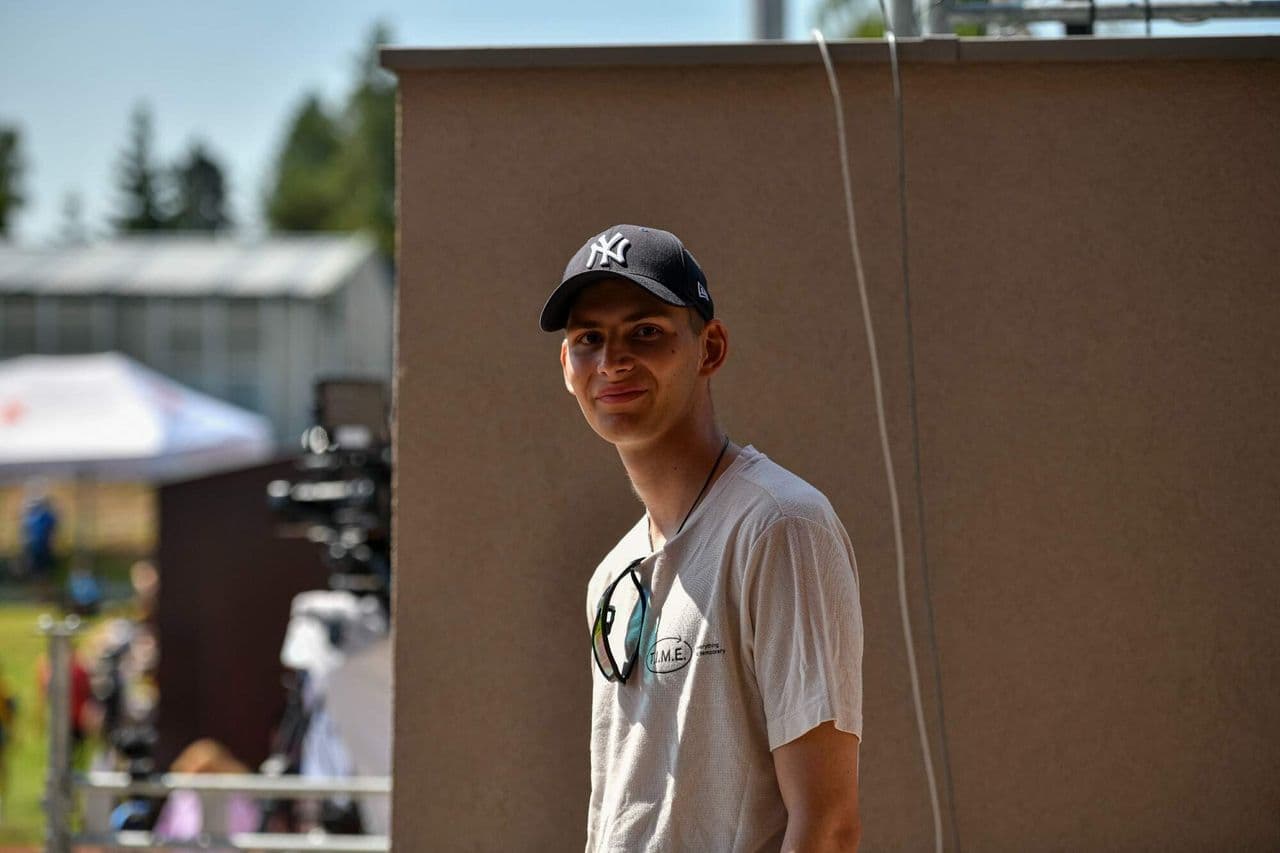
A record and the context of reconditioning training
Return to Movement and Sport After a Bone Marrow Transplant: The Case of the Decathlete Petr Svoboda
Abstract
This case study sets out the experience and the detailed training records of one athlete's return after a bone marrow transplant for acute lymphoblastic leukaemia (ALL): the case of Petr Svoboda.
It follows the whole case from the coach's point of view — from hospitalisation, through the transplant and the resumption of everyday movement in the summer of 2025, to a symbolic return to competition in June 2026. Its focus is what had to be weighed up in training, given the consequences of a life-threatening illness and gruelling treatment.
The first part sets out a number of difficult circumstances that preceded the return to movement and that are not obvious from outside. It gives the details of the treatment as a counterweight to how straightforward Petr's return can look in the media or on social media. Posts online do not show the daily struggle, the fatigue, the bad spells and the mental strain — nor, on the other side, the many good moments this case also holds.
The second part sets out the training principles chosen, the training load and the specific exercises, with videos. It also includes a record of general training indicators and of the load actually completed. The text closes with several further observations on the process as a whole.
This is one specific case, not a general protocol — that has to be said plainly. With illnesses of comparable severity, each case has to be judged individually and carefully. Even so, the experience here may be of use for other returns after illness or injury, whether serious or less so. The text rests on objective indicators, but it is written from a personal standpoint — with a degree of attachment, if you like — so read it with that in mind. It is published with Petr Svoboda's approval and after his own edits.
Basic timeline
To help orient the reader, we first set out a timeline of how the illness progressed and how the return to movement and then to athletics training unfolded:
2024
- November – diagnosis of acute leukaemia, admission to the Institute of Haematology and Blood Transfusion (ÚHKT), first round of chemotherapy
- December – the first round judged insufficiently effective, a stronger block of chemotherapy started, bone marrow transplant indicated
2025
- January – 3 January 2025 – MRD-negative – no detectable disease in the body, transplant under consideration; discharged into home care
- January – 13 January 2025 – the need for a transplant confirmed, two fully matched donors found in the donor registry (Poland and Germany)
- January – hospitalisation as planned from 17 January 2025, a so-called consolidation stay, 21 days of chemotherapy
- February – home care
- March – hospitalisation from 11 March 2025, bone marrow transplant on 20 March
- April – discharged into home care
- June – first discussions and the agreement on training, once basic recovery was under way
- July – return to everyday movement
- August – recovery continues, everyday movement, an increase in active movement
- September – the start of gradually more structured training
- October – the start of working for the Czech Athletic Federation
2026
- January – the work for the Czech Athletic Federation extended
- March – one year since the transplant, the training framework gradually adjusted
- June – the first training session in spikes since the transplant and preparation for competition
The illness and the context of the case
Acute lymphoblastic leukaemia (ALL) is a malignant disease of blood formation in which immature blood cells, incapable of functioning properly, multiply uncontrollably in the bone marrow. These cells crowd out normal blood formation, so the body begins to lack healthy white cells, red cells and platelets. Without timely treatment this can lead to life-threatening infections, sepsis, bleeding or organ failure. ALL affects children above all, but it also occurs in adults. It comes on virtually overnight and turns a person's life upside down.
Petr Svoboda's health problems began at a training camp in the Tatras in October 2024. At that time the Tábor athlete was planning a move to Prague, to Roman Šebrle's group, to take up decathlon training in full and continue his push to become a senior combined-events athlete. During the camp, though, he ran into breathing difficulties and unusual fatigue. Fortunately he decided to see a doctor before flying out to the next camp, and the doctors caught the rapid onset of acute leukaemia.
The news of his serious illness hit me hard. Petr and I have known each other since he was a youth athlete competing against athletes I coached. On top of that, Petr's coach Tereza Molvová later worked with me at the Czech Athletic Federation. We also had Petr in the programme supporting talented athletes up to the age of 22. By then he had already competed at the World U20 Championships and the European U20 Championships.
Soon after the news of the illness Petr and I spoke on the phone. Above all I wanted to encourage him, and also to learn the details of the disease and the expected course ahead. I promised him I would support him however I could. Symbolically, we therefore kept Petr in the Czech Athletic Federation (ČAS) talent programme in 2025 as well, when he was already dealing with recovery after demanding treatment. Support reached Petr from many sides. He had numerous visitors in hospital, so I went to see him in person only after that first wave of visits had passed.
My one and only visit to Petr at ÚHKT (the Institute of Haematology and Blood Transfusion) took place on 1 December 2024. He was just finishing the first round of chemotherapy, not even a month after the diagnosis. My job, as he had put it in his message, was mainly to bring good cheer. I wanted to bring him something else as well: hope, a vision. That was where we first talked about a possible return to sport. I promised him that when he was able to come back to sport, to athletics, I would be glad to help. I did not have direct coaching in mind so much as coordinating and advising on the return as a whole. Although I did not yet know all the details of the illness and its treatment, I knew the return would not be easy and would demand a specific approach — not only to training, but first of all to recovering from a serious illness. Petr's attitude to it all at that time was extremely positive. He believed he would soon be back in sport, that he would beat the illness. That mindset, at times almost naively optimistic, was decisive both for getting through the illness and for the reconditioning training that followed.
Even returns after ordinary long illnesses are often demanding, let alone after treatment for acute leukaemia. Once the bone marrow transplant had been decided on, it was clear that everything would be harder still. The main reason is the treatment itself, which places an extraordinary burden on the body; its principles are described below. Even then, though, Petr had studied the cases of various athletes who had managed to return to sport after transplants of different kinds. Athletics was his life, and the prospect of coming back one day gave him a goal and the strength to cope with everything better.
How the training partnership came about
The first meeting after the transplant
The second time we talked about a possible return was after the bone marrow transplant. It went ahead in the end because the preceding treatment had not been effective enough. For Petr, the date of the transplant is essentially a second birthday. It was the pivotal step in his treatment and the key chance of controlling the disease long-term.
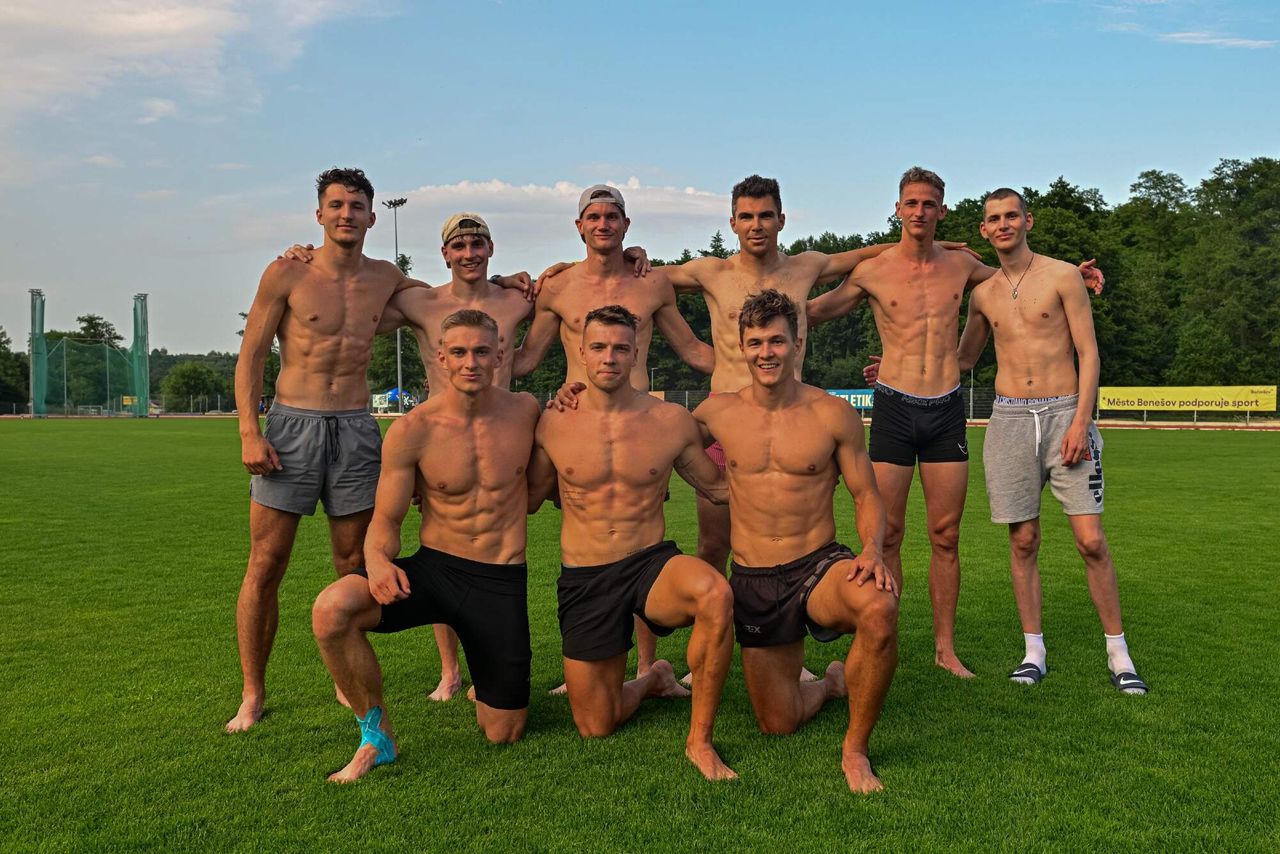
About three months after the transplant, Petr and I met at the Czech Combined Events Championships in Benešov. Petr had been invited there by David Bor (head of the ČAS competitions department, who knew Petr personally from Tábor) to commentate on part of the competition. It was an iconic moment. Petr commentated on the men's event, on his former training partners and friends. In the Czech Republic the combined-events athletes all know one another, and they had supported Petr from the beginning of his illness. As Petr commentated on their performances, you could feel how much the lads were enjoying it and, at the same time, how they were trying to give everything they had. As if they were jumping, throwing and running for him as well. His commentary gave the competition real energy and humour. Unlike other commentators, Petr could allow himself more personal remarks. After the competition a photograph was taken that captures the consequences of Petr's illness.
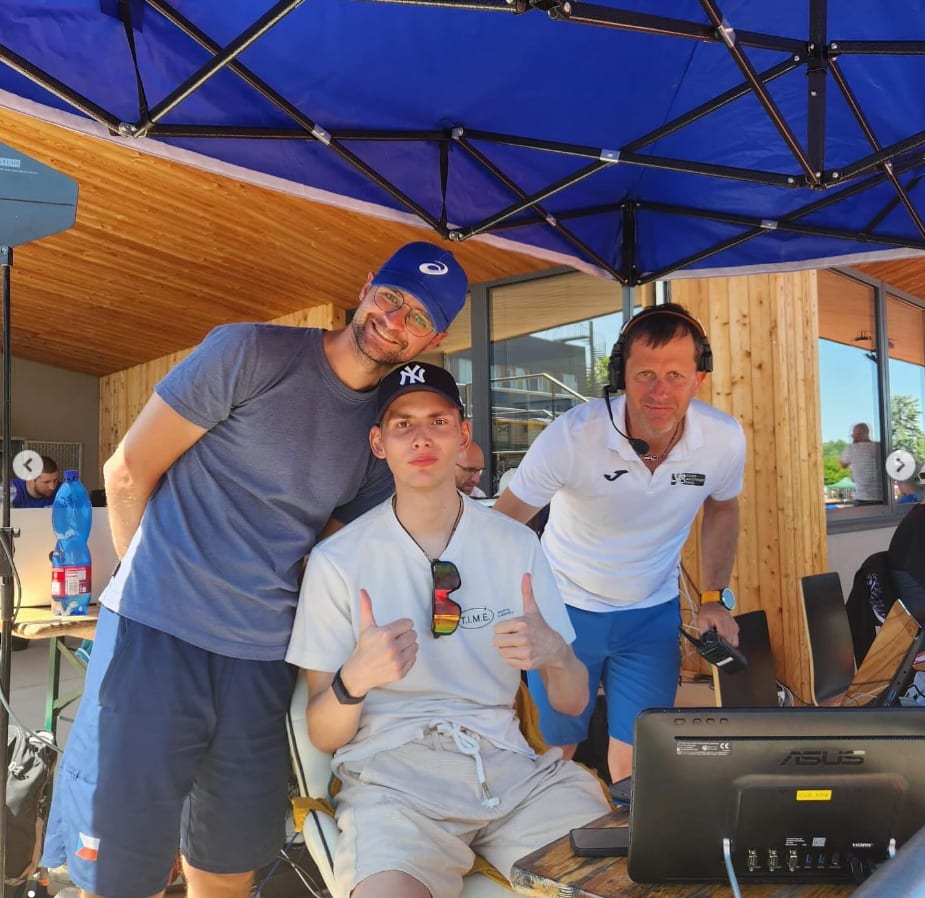
Because I was at the same championships as a coach, I was able to watch Petr. He was weak, thin, pale. At some moments his whole body shook, visibly weakened by the long illness. You could hear it in his voice, which wavered at times. During one of the breaks we discussed the return to sport. He asked for my opinion on how to proceed. A great many questions came up — at that point there were more questions than answers. Petr probably had not expected how many things would have to be weighed up in this bold plan. What was clear was his desire to come back.
The coach's role in the context of the whole case
From the start I saw my coaching role as the last one in the chain. What decided everything was Petr's medical condition and, fortunately, how well he has accepted the donor graft so far. Next came the doctors and nurses, who ran his treatment and kept up the regular check-ups. His family played an irreplaceable role, giving him every possible support. And none of it would have worked without Petr's own desire to return to sport. From the first diagnosis he approached the whole treatment incredibly positively, despite the many hard situations he met along the way. Only at the end of all that came our — my — effort to bring him back into sporting life.
At first I defined my role as dealing with Petr's physical condition and improving it. It gradually widened into a number of other areas, given the context of the illness, the treatment and the recovery. Far more things bore on Petr's „physical condition in training“ than with an ordinary athlete. Together we dealt not only with training and specific exercises but, with varying frequency, with travel, physiotherapy, medication, supplementary movement, commitments outside training and getting back into an active life. That is what I turn to below.
Questions about the return after a transplant
Following my discussion with Petr about the return to sport, I sent him several points and questions. I also set out my view of how we should probably proceed as far as training was concerned. Here is the original version in full (written under the title „Petr Svoboda – return to sport“, 16 June 2025):
„Questions for the doctors, assuming he is relatively well and it is possible to move further towards regular movement/sport:
- Can a point be identified at which a gradual return to regular movement is possible?
- Is sport in general a risk factor in any respect with regard to a possible relapse?
So it is more a matter of making sure that sport does not overload the body to the point of a marked drop in immunity or a serious injury. With a gradual return, that should not be a problem.
- Can an injury — muscular, connective-tissue or bone (a fracture) — affect the course of the treatment/recovery?
- What is the recommended procedure for returning to physical activity?
- What risks may come with a return to regular physical activity?
- To what extent did the treatment (chemotherapy, immunotherapy) affect the internal environment and the organs, and which ones? Heart, liver, kidneys, digestive system.
- To what extent did the treatment affect the function of the musculoskeletal system? (Muscles, connective tissue, bones)
- From that point of view, is it better to start with sports that place less structural load on the body (cycling, swimming, active walking with poles, running with poles, cross-country skiing)? I assume the logical answer is yes, and then to proceed in the standard way with a gradual increase in load and difficulty of the exercises.
Is it advisable, to be safe, to undergo some form of sports medical examination regularly after the return to sport? Or is that effectively covered already by the monitoring of the disease itself?
- ECG
- Exercise tests (adapted or lighter, if need be)
- Internal markers (blood, urine)
Can any particular form of movement or sport carry more risk?
What kind of load is most suitable at the beginning, and why?
- Is general conditioning work preferable? Or strength work? Or endurance? Anaerobic/aerobic? Or does it not matter and it is only about the physiological effects/preferences? Is it better to strengthen the skeleton first and then work on fitness (for example shorter sessions without a large physiological load)?
Do we know of any patients in the Czech Republic who returned to sport systematically? Can they be contacted?
- It would be instructive to know their story: whether they ran into problems during the return, how they dealt with them, what their experience was.
- Are there cases anywhere in the world of a return to a high sporting level after similar treatment? How did they go about it?
How I would proceed towards a return to sport:
Consult the doctors on the above. Once they give the green light for a gradual return, move on to the next steps.
Consultation with a sports physician and with a coach who will oversee the whole sporting regime.
Arrange a coach who will keep track of the overall condition and consult the others involved:
- Coach
- Physiotherapist
- Cooperating coaches, if applicable
- Doctor (oncologist + sports physician)
Set a genuinely long-term, gradual plan for the load. Roughly four-week cycles over one to two years, always with selected activities and a controlled volume. My assumption is that for the first six months or so the ideal regime would be:
- 3× a week about 60 minutes of lighter activity,
- 1–2× a week physiotherapy exercises
- Supplementary exercises daily, 20–30 minutes.
- Plus ordinary everyday movement, of course.“
Petr soon obtained answers from his attending physician. They were pragmatic and realistic at once, and they contained a number of unknowns alongside some recommendations concrete enough to act on:
ÚHKT: answers from the attending physician
A bone marrow transplant (SCT) is a major intervention for the body. Complications after treatment often arise suddenly and the condition can change from day to day. The priority now is monitoring the state of the disease (checking that remission holds), the function of the transplanted graft (blood counts) and the development of complications — above all graft-versus-host disease, which can develop even a long time after the transplant and affect organs such as the skin, joints, muscles, tendons, mucous membranes, liver, lungs and so on (the most severe form arises in about 60 % of patients, with varying localisation and intensity).
Further complications may be infections related to the use of immunosuppressants and to the inadequate function of the immune system after the transplant (immune reconstitution generally takes 2–3 years). The patient faces a vaccination schedule, which starts at the earliest 7–8 months after SCT. I will therefore describe only the ideal situation, in which the disease does not return after the transplant, no severe graft-versus-host disease appears (treating it requires increasing the immunosuppressants and adding corticosteroids — and with that come side effects such as oedema, muscle weakening, susceptibility to infection and so on) and it is possible to withdraw the immunosuppressants gradually.
If the patient has no serious complications, recovery is very gradual and highly individual; it cannot be generalised. In general:
- 3 months after SCT – immunity is at its most deficient; physical activity is usually very limited and only activity such as walking is recommended (it can be lengthened gradually), possibly with physiotherapy (rehabilitation) and breathing exercises. up to six months after SCT a gradual increase in load; walking, swimming, a stationary bike and very light strength work are recommended. No targeted sports training is recommended.
- 6–12 months after SCT – a very gradual return to sport is possible; contact sports and sports carrying a risk of injury or infection are not recommended. Basic strength and coordination exercises are recommended, along with work on mobility and core stability. Exercise without heavy load and without impact. Light running is possible.- 1 year after SCT – a gradual return to full load is possible — to specialised training, under expert supervision. A return to the training the athlete is used to only after roughly 1.5 years. Suitable activities in the first year: cycling, walking, swimming, light bodyweight strength work, stretching. Unsuitable activities in the first year: long-distance running, heavy strength training, contact sports, team sports, public swimming pools, fitness centres.
A return to the original level can be expected only on condition that the patient is free of complications, and only after a long recovery — at the earliest 1–2 years after SCT. Given the above and the regular check-ups at ÚHKT, there is currently no need to plan special sports medical examinations or exercise tests. The question can be reopened a year after the transplant, and everything will be guided by the patient's condition at that time.
Personally I do not know of any elite athlete who has undergone a bone marrow transplant, but I know many patients who live a good life without complications or functional limitations, so we have to hope it will be the same in this case.“
After exchanging these messages Petr and I spoke on the phone, went through the circumstances and agreed that we would start training together. In putting the programme together I also worked from the ÚHKT recommendations above.
What were the goals?
- A return to regular physical activity
To bring Petr back to regular physical activity, within whatever his current condition allowed. Sport was and is fundamental to Petr's life. The primary goal was therefore to give Petr back his greatest joy. At the same time it was meant to be a kind of return to normality for body and mind alike. And if it turned out to be possible, to move on towards a return to competing in athletics. - Physical and mental health
Sport and movement were to serve as a basic preventive measure against other difficulties. Weighing up the risks of a demanding recovery, we agreed that a stronger body — physically and mentally — is the better option. Being in good shape before the leukaemia was one of the key factors that let Petr tolerate and get through the whole course of treatment relatively well. Had he started in worse shape, the impact on the body would probably have been far more destructive. It is clear that in this case training played an important role precisely in the area of mental health. - Social goals
Training was meant to offer an environment in which Petr was an athlete — not „the one with leukaemia.“ On top of that, after a long illness that inevitably brings great isolation, training in a group was an important social anchor. In training I treated him more or less like any other athlete. I ask every athlete I coach about their condition (niggles, injuries, illness, health, general wellbeing) and then we train; in that at least he was no exception. Petr's presence at training also made the rest of the group reflect on their own commitment. Of course Petr could not manage everything the others did, but his positive attitude was an example to everyone.
Treatment for acute leukaemia, its consequences and its effect on training
The course of treatment
Before training could begin, the circumstances of the completed treatment had to be weighed up. In Petr's case it followed the standard logic of ALL treatment: reaching remission step by step, then reducing the risk of the disease returning, and finally a haematopoietic cell transplant. The diagnosis was followed by intensive chemotherapy aimed at suppressing the leukaemic cells in the blood and bone marrow as quickly as possible and restoring normal blood formation. In January 2025 came the next planned phase of treatment, comprising a second round of chemotherapy and immunotherapy. Petr's condition after the first rounds of chemotherapy, and the consequences of that treatment, are captured by the video of a vertical jump from January 2025.
Vertical jump after the first round of chemotherapy, January 2025
Given the subsequent course of the disease, a bone marrow transplant was then indicated. That is not always necessary. Petr's body had probably not responded sufficiently to the treatment so far, and so the doctors decided on the transplant option. It was preceded by conditioning treatment, which places an extraordinary burden on the body, since its aim is to suppress the original diseased blood formation and prepare the body to accept the donor graft. That phase was probably one of the hardest.
The transplant itself consists of administering haematopoietic cells from a donor, which are to restore the patient's blood formation and at the same time bring a new immune system capable of helping to control any residual leukaemic cells. The transplant is followed by a long period of recovery, during which the acceptance of the graft, the restoration of blood formation, the state of immunity and possible complications are all monitored. The most important of these are infectious complications, graft-versus-host disease and the side effects of immunosuppressive treatment. What is being monitored, then, is above all the gradual restoration of the whole organism after long and very demanding treatment.
The treatment from a training point of view
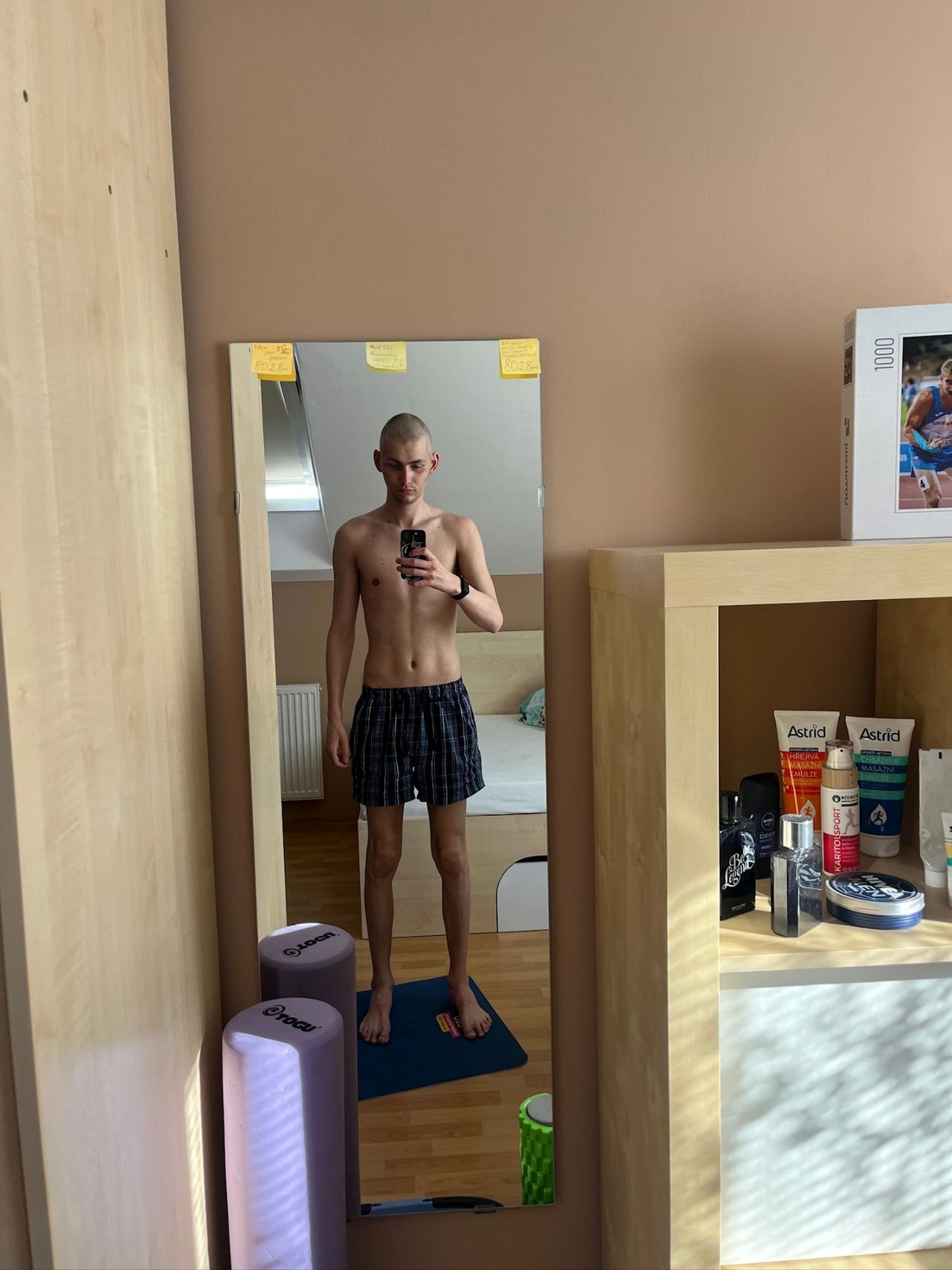
From the point of view of future sporting load, what mattered was that treatment for ALL does not target the leukaemia alone but also a range of healthy tissues and systems. Chemotherapy and the conditioning regime before the transplant lead to a marked loss of muscle mass (in the first 57 days of hospitalisation alone Petr lost 12 kg of body weight), a drop in strength, poorer tolerance of load, anaemia, general fatigue and slower recovery. They can also place a burden on the organs that matter for physical performance, especially the heart, lungs, liver, kidneys and digestive system. After the transplant come long-term weakened immunity, the risk of infection, possible graft-versus-host disease and the effect of immunosuppressants and corticosteroids on muscles, bones, metabolism and mental state. The return to training therefore could not be understood merely as a gradual build-up of fitness, but as a cautious rebuilding of the body's overall functional capacity.
Medication
A bone marrow transplant does not mean the end of treatment. Treatment is long-term and in many cases lifelong. The aim of the follow-up treatment is to keep the disease under control, and medication at varying doses is one of the means to that end. Throughout the first year of our work together Petr was essentially always on medication. It significantly affected his condition, his recovery and his training.
Corticosteroids
The aim of giving corticosteroids after a bone marrow transplant is mainly to suppress an unwanted immune reaction, above all GVHD (see below). Ideally the dose is reduced gradually during treatment, but more often it fluctuates — it is adjusted according to the clinical picture. In Petr's case it was adjusted several times over the year. The doctors raised the dose practically whenever any suspicious sign appeared (itching skin, an itchy throat, a temperature, intestinal trouble, test results) that might be connected with GVHD. The problem with corticosteroids is that they cover up ordinary physiological responses: they mask fatigue and create a feeling of energy. And fatigue is exactly what a coach needs to be able to read.
Petr often came across as unexpectedly energetic. Before long, though, he began to recognise for himself when his state was significantly affected by a raised corticosteroid dose and when it was down to something else (training, or fatigue from other sources). From a coaching point of view it was both important and demanding to keep the training load low, because with an ordinary athlete showing that kind of liveliness (during one of the hurdle run-throughs, say) we would have carried on with the session without a second thought.
So we were sometimes in a situation where I ended Petr's session as his coach even though he felt fine. Gradually I learned to read his fatigue and his condition over a longer horizon. With an ordinary athlete we usually weigh the effect of a session and the recovery that follows in terms of a few days. With Petr I gradually began to think in terms of weeks. How did he look a fortnight ago? How will he look a week from now, after today's session and the one two days from now?
Immunosuppressants
The aim of immunosuppressants after a bone marrow transplant is mainly to keep the immune reaction under control, so that the donor's immune cells do not start damaging the recipient's body. But, as the name suggests, immunosuppressants also lower the body's defences and therefore raise the risk of infection.
Especially in the first year after the transplant Petr was quite careful about his own hygiene and about being among larger numbers of people; he still does not travel by public transport, and he avoided spending long periods in the cold. Especially at the beginning we held sessions in the early afternoon, so that there would be as few people as possible in the training hall (and some quiet for the session). In the winter months, because of the risk of catching cold, we trained almost exclusively indoors (in good weather Petr was happy to get outdoor movement on his own at other times).
Preventive antivirals, antifungals and antibiotics
The aim of this medication is to reduce the risk of infection at the time when immunity is most weakened and suppressed. The doses were gradually reduced, but certain doses of antivirals and antibiotics will remain for as long as immunosuppressants are being taken. The side effects can vary, but above all they place a burden of differing degrees on the internal organs.
This is not a complete list of the medication Petr was taking, but even this basic mix makes clear how much it shaped the way he came across, and how far it masked his real state at certain stages. In the first six months especially he went through large swings tied to corticosteroid dosing. That is one reason I had a healthy respect for prescribing any training at all, just as I always quietly worried he might overdo it when he went out on the bike or for a walk in the mountains. One more practical consequence: for ordinary athletics competition, a therapeutic use exemption would have to be obtained for some of the drugs he is given.
The vaccination framework
Alongside the medication came the need to rebuild immunity and protection against infection through a new vaccination schedule. The immune system after a transplant is markedly weakened and has to rebuild many previously acquired defences from scratch. In this sense a patient after a transplant is sometimes compared to a newborn, because their immunological memory and protection against common infections can be significantly reduced.
Petr had four vaccinations during the period covered here. After each one we assumed at least 2 days off training. In one case a flu-like reaction with chills followed some 3–4 days after the vaccination. In another, the following 2 days or so were affected by heavy fatigue. In both cases, fortunately, there were no longer-term consequences. As a precaution, however, it meant several more days without physical activity. In two cases we saw no adverse reaction.
GVHD
One of the most closely watched factors after a bone marrow transplant is GVHD (Graft-versus-Host Disease, or the reaction of the graft against the host). It is a serious complication after an allogeneic (that is, coming from another individual of the same species) haematopoietic cell transplant, in which the donor's immune cells recognise the recipient's tissues as foreign and start attacking them. It most often affects the skin, the digestive tract, the liver, mucous membranes, eyes, lungs or the musculoskeletal system, and it can significantly affect both recovery and the return to physical load. GVHD is also one of the reasons medication is reduced gradually and under regular medical supervision. The doctors watch how the body is accepting the graft. As soon as they see any unusual signs from an organ, they adjust the medication.
How the GVHD showed itself
In Petr's case GVHD appeared more markedly twice:
- The first more serious reaction came in January 2026. It began as non-specific abdominal pain and then moved to the intestines. After the medication was increased the symptoms fortunately settled and did not recur. It was an unpleasant situation, above all because at first it was not clear whether the cause of the pain was GVHD or some infection or the like. The internal pain was also reflected in the muscular and connective-tissue wall of the abdomen, where Petr subsequently dealt with stiff muscles and a blocked trunk with his physiotherapist.
- The second, longer-lasting sign was an unpleasant skin rash, mainly on the hands, forearms, the inner elbows and around the neck. Set against the possible more serious manifestations of GVHD, a rash is undoubtedly one of the milder ones. Even so, the doctors responded to it several times by adjusting the medication — both corticosteroids and immunosuppressants. The symptoms worsened with a higher overall load (a combination of travel, training, work or other responsibilities) and also in the sun — which had practical consequences for training in the spring and summer of 2026, when time in the sun had to be kept to a minimum.
Physiotherapy
The basic problems
Regular physiotherapy was fundamental to the whole process. In the first phase it mattered for preventive and reconditioning reasons:
- General stiffness and reduced mobility following months of minimal physical activity. Physiotherapy was to identify the most problematic areas and work through them step by step.
- The body was marked by significant muscle atrophy. Among other things, physiotherapy helped identify the primary areas that needed strengthening.
- The intravenous cannulas left particular areas of the groin and shoulder sensitive and stiff (where the cannulas had been inserted). Both areas tended to cramp or stiffen, which then cascaded into other areas (the trunk and ribs above all).
- Physiotherapy was at the same time another training session for Petr, with far smaller demands on energy and far less structural load — in his condition it was effectively a full training unit.
Acute physiotherapy problems
Among the more acute issues that had to be dealt with during the year:
- Pain and marked sensitivity in the calves , which showed up as pain, tenderness, a sense of the calves seizing up, and stiffness after the first months of movement, at the turn of November and December 2025. It was probably the result of several factors we failed to anticipate — above all the early introduction of small rhythm and sprint drills, whose total volume (not the volume within a single session) was too sharp a contrast for a body that had left that area idle for so long.
- Blocked ribs and trunk were something we dealt with repeatedly, as a result of training (stiffness after strength work), ordinary life (long spells in the car, sleeping awkwardly) and illness (following the abdominal pain, for instance). Petr had also carried some poor movement patterns around the shoulders and chest muscles from earlier years. Over the year we managed to work on that area significantly.
- Abdominal pain, which had an internal cause but, logically enough, also showed up as tightening of the muscles across the whole area.
- A blocked coccyx and SI joint, which needed releasing. There could have been several reasons, among them frequent driving.
- Pain in the instep, which fortunately was very brief and soon passed.
Fortunately none of the problems we dealt with were serious. The most troublesome was the calf pain, which did resolve in the end, though it took time. As a coach my subjective read was that the triggers of pain in Petr were far smaller and more ordinary than they would have been in a healthy athlete. His body also reacted to every problem more strongly, and recovery took longer. Petr himself was careful too. Any unusual pain was unwelcome throughout the process for the reasons above. At the slightest doubt it was better to shorten the session, adjust it or skip it.
Petr arranged regular physiotherapy with the physiotherapist Petra Kuželková, whom he knew well from his time in Tábor. He tried to keep the visits weekly at the start; later they were less frequent but still regular. He also dealt with smaller acute problems several times with the Prague physiotherapist Michal Drahota, who likewise knew Petr from international events and earlier work together. Petr always told me what had been treated at a given session and what recommendations came out of it. In general I have great confidence in the physiotherapists we work with, so I respect their suggestions for training, and I consulted them directly about Petr's case several times.
Every cloud has a silver lining. Regular physiotherapy gave Petr the chance to work on some weaknesses that had limited him even before: hip mobility above all, glute activation, core engagement, control of the body. After a year of it, and of course of his own exercises, he felt a substantial improvement in overall mobility. The improved ranges showed above all around the groin and the lumbar–hip area — and so far in the absence of muscle problems. Over the 42 weeks from September 2025 to June 2026 Petr completed 22 physiotherapy sessions: more than one a fortnight, a rate higher than most healthy athletes manage. It is also worth saying that he was very proactive and positive about dealing with musculoskeletal problems, which helped the whole process considerably.
Unexpected and unexplained twitching of the inner thighs. One more of the unpredictable manifestations of the whole process — fortunately a one-off. March 2026.
Stress outside training
With every athlete you have to deal not only with training stress but with everything else — school, the family situation, work, travel, some sense of their personal life — all of which affects how well training is absorbed. With Petr I dealt with much of that far more closely than usual. At the beginning even ordinary activities placed a heavy load on him; several times he reported major fatigue or strain after quite ordinary, easy things. Later it settled down, but we kept weighing his everyday commitments against training and his overall condition, above all:
- Travel, which for Petr meant mainly the trips between Tábor, where he lived, and Prague, where he went for check-ups, occasional meetings and training. Precisely because travel was demanding, the ratio of sessions in Tábor to sessions in Prague ended up at roughly 1:1. Often we preferred a session in Tábor without a coach over one in Prague with a coach but with the travel on top.
- Two commentary jobs — the Czech Combined Events Championships indoors and outdoors, which David Bor (head of the competitions department) invited him to do, were a major intrusion into the training regime. Commentating was of course also part of the effort to keep Petr in touch with his event and with the group he had had to leave because of the illness. In both cases, then, the good was mixed with the demanding. Both events were physically and mentally taxing for Petr, so I chose a lighter regime beforehand. Even so, both were followed, as expected, by considerable fatigue and therefore by days off.
- Further media work, public appearances and various events that Petr took part in during the year. Because of his story and with help from various foundations he took part in several charity events, photo shoots and the like. He also did several filming sessions and, for example, an autograph session for children at an athletics meeting.
It is worth saying that although these events may have been an unnecessary load in training terms, they mattered at the same time — and not only to him. Petr's involvement in projects around bone marrow donation was especially inspiring, and it still reaches well beyond sport.
The return to movement and training
The return to movement: July and August 2025
Petr managed the first two months, July and August, himself, following the basic guidance I had sent him. Any systematic or more demanding training made no sense at that point — it was not even possible. After months without movement the body first had to adapt to ordinary everyday load. Petr was genuinely dealing with fatigue from one day to the next. His condition and his energy often changed within a single day. The medication played a part in that too, and combined with various other stressors it created an extremely variable environment.
In the first month training meant ordinary walks, climbing stairs, standing on his feet for longer periods, and physiotherapy. In terms of sporting activity Petr played table tennis regularly, occasionally tried short bike rides, and did basic strength and stabilisation exercises. That even this basic regime was not easy is clear from his training diary entries from the first week:
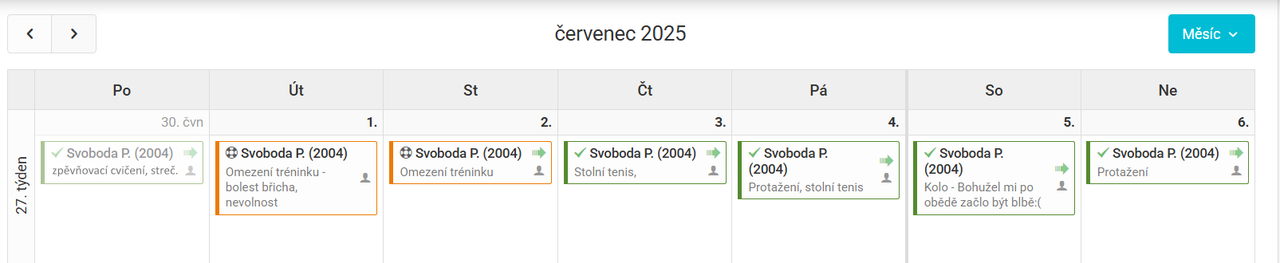
The goal of the summer months, then, was to start moving in a completely ordinary way and to draw strength from the good weather (we expected autumn and winter to be harder). Another important goal was to find a daily routine that worked and to start recognising when it was right to take on a light load, how the body responds to it and how much recovery it needs — simply to listen to his own body. One thing was certain: the mind responds to movement wonderfully. At this stage any movement at all was a release for Petr after many months of enforced inactivity.
Petr also tracked his HRV (heart rate variability) and resting heart rate himself. The body was gradually settling and the values were returning to normal. He passed the data on to me from time to time in the following months as well. Thanks to long-term tracking he was already able to recognise the connection between a poorer reading on either variable and his current state, and he adjusted his daily load accordingly.
In August he gradually added more physical activity. The improvement in his physical condition was striking. The message Petr sent me on 14 August, taking stock of the progress so far, is fascinating:
Hi, I feel really good now and I have the sense that it's moving in the right direction. This week we were in the Polish Krkonoše with the family and I was surprised by how much I managed. Around 15 thousand steps every day, and on Tuesday even a 16 km hike with a thousand metres of climbing, and my body handled it completely fine, I wasn't even particularly wrecked afterwards. The numbers from my Whoop pleased me a lot too. My resting heart rate, which had stayed around 80 since the start of treatment, has dropped back to 50–60 over the last three weeks. The corticosteroids I'm taking for mild skin GVHD probably have something to do with it, but even so I feel recovery is in a very different place than it was a month ago. In July I went to physio once a week (mainly mobility, stabilisation), plus one strength session at home, and almost every day I played an hour of table tennis and went for brisker walks. There were still weaker days now and then, when I was completely switched off. Since August I've added the pull-up bar — three shorter sessions a week, under an hour — and at the stadium I've tried a few runs up the steps. Overall I see it very positively, though I'm still watching that I don't overcook it straight away. I'd like to drop in at Spartak now, though, and maybe talk it all through with you in person. For August I think it will still be best to go by feel, but from September I'd be happy to come to Prague at least once a week and train with someone.
The message shows clearly how strongly the medication affected Petr by masking his sense of fatigue. A 16 km mountain hike is demanding even for a healthy person. What mattered was that he was getting his body moving regularly, under a basic load, and that his condition was improving by the day.
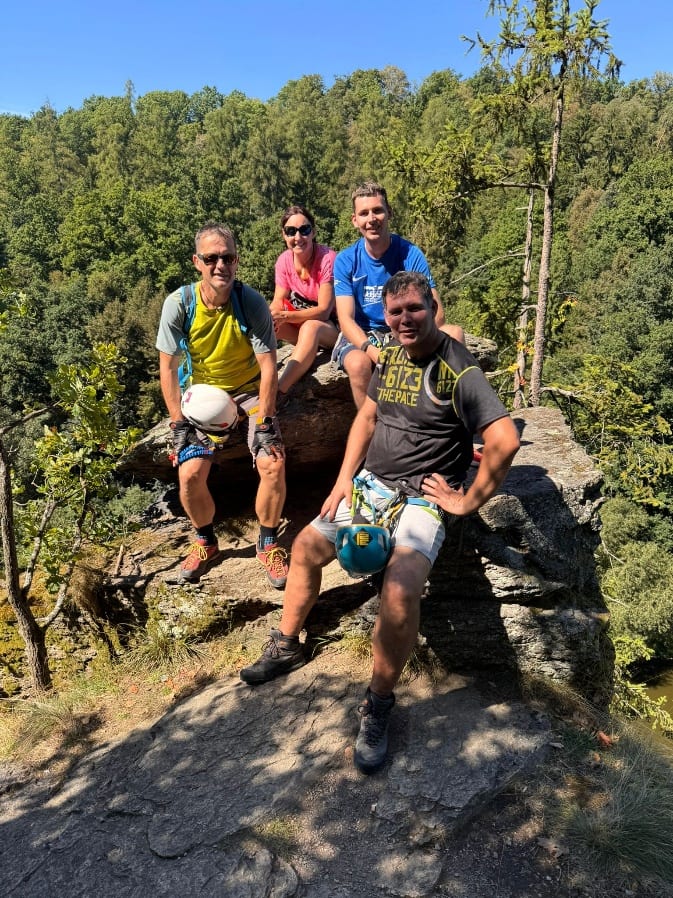
The first six months of training (September 2025 – February 2026)
Although his condition improved after the first two months of basic movement, the gap compared with a healthy peer was still enormous. We recorded Petr's first training session in Prague on several videos, which effectively show his starting point.
Given the course and the consequences of the treatment described above, and the first sessions themselves, I had well-founded concerns about many things in the first six months. Nobody could realistically judge what state the whole system, inside and out, was in after the treatment. How extensive the damage was, and how well certain organs (kidneys, liver, intestines, lungs, heart…) were working when it came to handling training, is essentially still unclear. But internal function underpins how the body works and how it recovers and adapts, and I had to allow for that.
Naturally there was also the state of the muscular, connective-tissue and skeletal system. I assessed the extent of the damage to outward movement gradually (with the help of physiotherapy), but only in part. Nobody can see down to the cellular level and the quality of the tissues behind movement (muscles, ligaments, connective sheaths, fascia…). After treatment for ALL, the risk of muscle injury is reported to be considerably higher, as is susceptibility to other structural injuries, above all fractures, as a result of the side effects of the whole treatment (osteoporosis, muscle atrophy, anaemia, muscle weakness…). My concern also stemmed from the fact that Petr had in reality gone more than 10 months without any demanding structural load. Even with healthy people who have not trained for a long time, we weigh carefully the moment of introducing more demanding specific training, for fear of various injuries and of needless overload from excessive training. In athletics, too rapid an increase in load most often produces pain in the Achilles tendons, the shins, the knees, and in throwing the elbow or shoulder.
All the more, then, I was wary of fast movements and high intensity. The higher the speed, the greater the overload on the whole apparatus. On top of that Petr has a natural tendency to move fast, actively and elastically, which in his condition was not entirely desirable — at least in the early phases. Keeping Petr at lower intensity and speed, however, worked only with mixed success. His nature often won out. And the combination of the risks described above with precisely that early increase in faster movement probably lay behind the calf pain of November and December 2025.
The basic approach to training in the first six months
Having weighed up everything described above, we began training that was to hold to the following principles for roughly 3–6 months:
- 2× a week a session of about 45–60 min depending on his condition
At the start especially, Petr could realistically sustain up to 60 minutes of activity, and that with frequent breaks. The time under load gradually lengthened, and at the same time it swung a great deal with the current medication. The one-hour limit, though, was always the basic frame for putting a session together. Compared with the rest of the group he could sustain an estimated 30 % of the activity at first, when he trained with them for part of a session. He regulated his rest mainly himself; only exceptionally did I set it. He had to feel ready for the next repetition. Conversely, if during an exercise he felt it was too much, he ended it himself. His condition improved week by week.
- 2× a week basic lighter physical activity
Ordinary movement (a walk, stretching, table tennis, yoga, bodyweight strength work, small compensatory exercises), which at this stage we effectively counted as training. Petr willingly sought out small recreational activities. What mattered was that he accepted this ordinary movement as part of training, including stretching, compensatory exercises and so on. - Regular physiotherapy
As described above, physiotherapy effectively replaced one training unit. Given how many problem areas Petr had after the treatment, physiotherapy was an indispensable part of training. - Low physiological load
The aim was not to overload the circulatory system or his energy reserves, given the unclear response of the body and its recovery. We also wanted to avoid excessive muscle fatigue. Training therefore consisted above all of small numbers of repetitions and small numbers of sets.
For example, Petr began bodyweight strength work at:
- about 4–5 exercises × 2–3 sets × 4–6 repetitions.
By the end of this period he managed:
- 6–8 exercises × 3–4 sets × 5–8 repetitions.
Sprint drills and any running activity moved similarly, from about 3 × 30 m @50–60 % to about 5–6 × 50 m @60–70 %. Most continuous efforts lasted up to about 15 s (at lower intensities).
- Low structural load
Out of concern for the state of the muscular and connective tissue and for potential injury, in the first part we left out all maximal-effort activity (and we still keep it to a very limited degree). Training contained almost no bounding exercises or demanding landings. In the first part it included bounding at most in the form of skipping variations, ankle bounces and hurdle walk-overs (low hurdles, max. 30 cm) and the like.
The first bounding exercises in September 2025, practically all of it skipping. The aim was to start restoring neuromuscular activation and to load the areas that matter in athletics — at very small volume and controlled intensity.
- An emphasis on long kinetic chains
Typical exercises in this group were variations from a squat or a lunge to standing with the arms overhead, or yoga variations of the „three legged dog“. I considered these exercises useful because they engaged several segments and demanded a degree of coordination and rhythm. In a situation where training time had to be used to the full, exercises of this kind looked like an efficient solution. - An emphasis on mobility
The added emphasis here was meant to relieve muscular load and to prevent needless injury caused by poor mobility. The focus was on the main joints — hips and shoulders — and on spinal mobility. - Avoiding needless mechanical injuries
...from a fall, a collision and the like, which would have been a problem on many fronts. Any fracture or accident would have been a major complication and carried a number of risks. Even so, Petr did have one accident, from an activity outside training: snowboarding (which he wanted to enjoy at least once during the winter), he fell into a skier's path and took a heavy blow to the face. - An absolute restriction on longer running (both in time and in distance). In the first six months everything took place over 20–80 m.
- Aerobic load only as part of ordinary movement at low intensity — walks, cycling. That includes, for instance, a short stay in the Tatras, where the load was certainly higher but to some extent natural.
Training from one year after the transplant onwards (March – June 2026)
A milestone of sorts was the one-year mark after the transplant, which is taken as a reference point for how well the treatment has gone. If everything proceeds without major complications, the risks associated with the treatment gradually fall away. Since the medical check-ups were coming back more or less positive, it was around March 2026 that I adjusted the original training framework. It rested on the following points:
- A gradual increase in physiological load.
- 2–3 sessions a week of about 60–80 min depending on his condition
Overall Petr's condition was improving quickly, though with weekly swings. Sometimes he completed more sessions than in the first period, still with frequent breaks. The swings with medication continued. By now we were working with a relatively normal session model of warm-up – main part – cool-down. Compared with the rest of the group he could now sustain an estimated 50–70 % of the activity (within the shared warm-up, for instance, not a whole session). He still regulated his rest mainly himself. Overall, though, his sense of when he was and was not ready had improved. And the situation was better every week. - Further physical activity and aerobic load according to his current state
After the experience of the first period we kept the model in which Petr simply sought out active movement himself according to how he felt (a walk, stretching, table tennis, yoga, bodyweight strength work, small compensatory exercises). In the spring he more often added rides on an e-bike, which proved a very suitable supplement because the intensity is far easier to regulate on it.
He again spent time in the mountains, this time in Austria with a relatively demanding programme. When he felt good, he held himself back nothing like as much as before.
- Regular physiotherapy, keeping the emphasis on mobility and compensatory exercises.
Regular physiotherapy continued. Dealing with more acute problems began to predominate.
He also fitted mobility and other exercises in on his own, outside training days. - An increase in physiological load
Given his improving condition we increased both the number of repetitions and the number of sets. Bodyweight strength work in this period, for example, ran to about 6–8 exercises × 2–4 sets × 6–10 repetitions depending on how demanding the exercise was. Sprint drills and running activity likewise increased gradually to about 3 × 50 m @60–80 % + 2 × 80 m @80–85 %. Most continuous efforts still stayed within about 15 s. Occasionally some light, short jogging or more continuous running, but very little overall. - A gradual return to basic bounding, sprint drills, straights and hurdle run-throughs
By the spring Petr could do these drills in something close to their normal form, including run-throughs over 5 hurdles with 5 strides between them at 91 cm, the spacing set 5 feet further apart. His endurance for higher repetition counts was still limited, so everything was repeated about 4–6 times. All of it rested on the earlier training, and the ranges of movement in hurdling, sprinting and jumping came out of the overall improvement in mobility.
In April Petr managed to complete5 days of a joint training camp in Olomouc. The regime was one session a day as described above + one bike ride a day, or rest. From his training diary (6 April 2026): „The camp was great, I think I got through more of it than in the whole of this year so far. I'm really glad my health held up!“.
Examples of training from Olomouc:
Further examples from the second half-year, June 2026
- More frequent strength training
The barbell, machines or bodyweight work were part of almost every session, even if only minimally. That also fitted the effort to get back to his original body weight and rebuild muscle. The resistance went up gradually: by the end of this period he was power cleaning 50 kg with good technique. More isolated exercises were also included (on machines or with other equipment) for selected areas (hips, hamstrings, adductors and glutes above all)
The videos of the progression of his power clean after the return to strength training offer a good comparison. The growth in strength is accompanied by gradual improvement in coordination and technique.
- Towards the end of the period, a gradual increase in specific exercises, but at lower intensities.
The restriction on maximal intensity remained. The aim was to adapt the body gradually to athletic load so that it would cope with a possible competitive start, at controlled effort. By the end of the period (May, June) he could manage longer sprints of 80–90 m at 80–90 %, jumps from a 6-stride approach and starts from blocks — all at controlled intensity.
Where things stood in mid-June 2026, that is 10 months after the start of reconditioning training:
- Video of speed work — starts before the departure for the Netherlands
The aim of the training was for Petr to put out a first post-transplant performance at the European Transplant Games, due to be held in the last week of June in the Netherlands. After a fair amount of arranging and preparation he drove there with his brother about four days before the competition. He completed one last session on site before, on the evening of 25 June, the Netherlands called off all public and sporting events because of the heatwave. So Petr never made his symbolic start, and we do not know „exactly“ where he stood in terms of athletics results. But that is not what matters — the road he travelled is. The videos above make it clear that 10 months into training and 15 months after the transplant he had reached a remarkable place.
Overview of the training completed
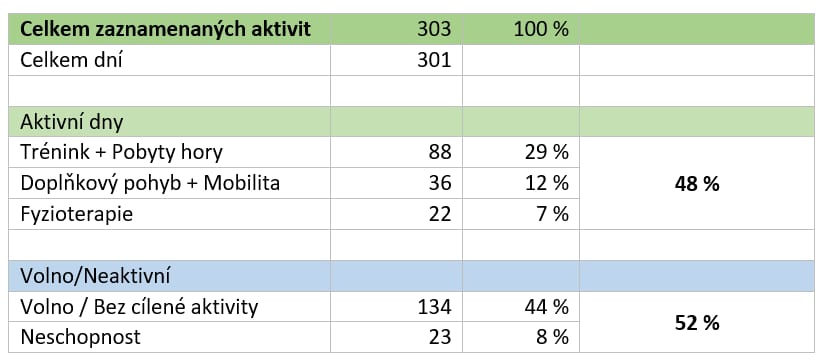
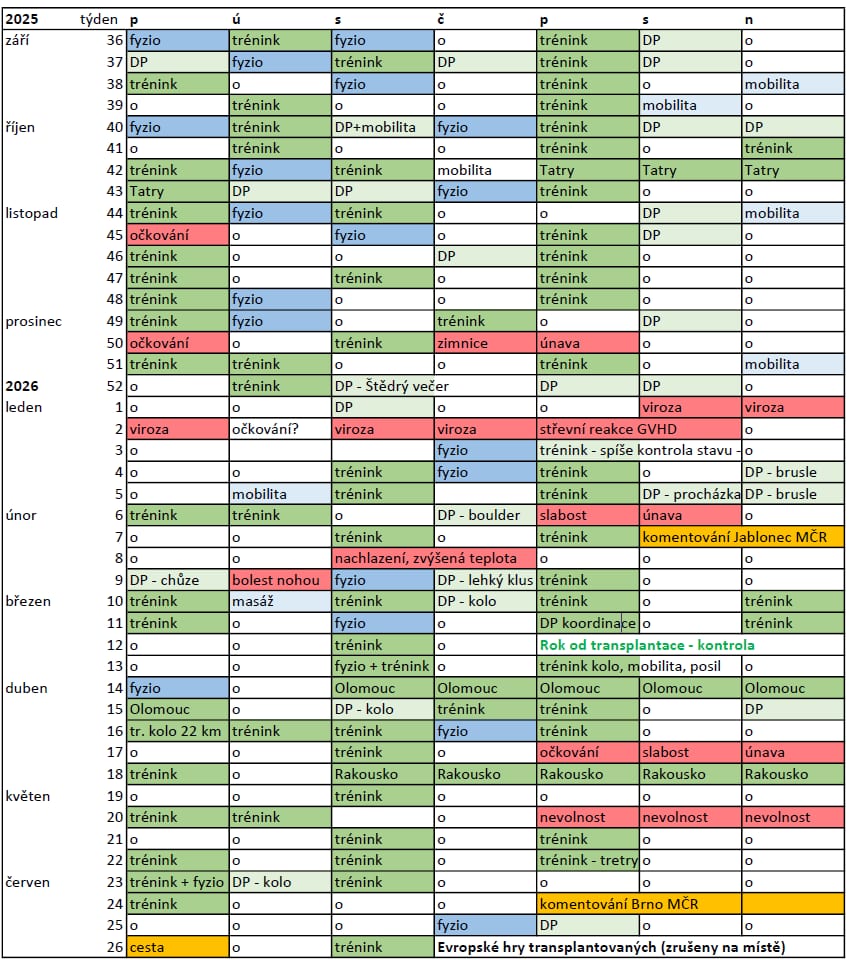
To give a more concrete sense of the frequency and the total amount of training completed, here is an overview of 301 tracked days (that is, 43 weeks) from September 2025 to June 2026, showing:
- Training = a session completed in Prague or in Tábor at the stadium / in the indoor tunnel / in the gym, according to the plan and the basic specifications above.
- Supplementary movement = completed according to plan or on his own initiative; most often e-bike riding, table tennis, brisk walks, and also his own strength work, core work, mobility work, basic gymnastics, skating and the like.
- Physiotherapy = scheduled physiotherapy, mostly in Tábor (P. Kuželková) or in Prague (M. Drahota; TJ Dukla Praha).
- Rest = a day with no planned activity and with no reported fatigue or acute incapacity
- Medical incapacity = days when physical activity was impossible for health reasons or because of marked fatigue.
- Demanding commitments = days when the planned physical activity did not take place, but the commitment itself was taxing.
The overview shows that the first stretch of training, September–October, was probably shaped significantly by the medication. It was, even so, an important opening phase — for starting regular physical activity and for working out the right way to proceed.
The hardest stretch was between December and February, when several complications came together: a viral infection, GVHD in the digestive tract and the calf pain.
March and April were very good from a training point of view. They showed that Petr would be able, albeit at controlled effort, to complete basic competitive starts and return to the track — taking into account, of course, all the factors that come into play in his case.
June was marked by several relatively good sessions (including in spikes), but also by a good deal of room for rest because of the planned commentary at the Czech Championships and the trip to the Netherlands.
The basic statistics come out on the positive side: 48 % were „active days“, counting training, supplementary movement plus mobility, and physiotherapy. Rest and incapacity made up the other 52 %, though training was directly prevented on only 8 % of days. Rest is a necessary part of training for healthy athletes too, even if in smaller measure. Overall I consider that balance very favourable, even unexpectedly so, given the starting point.
Further observations
The discussion about returning to competition
Around the one-year mark after the transplant, in March 2026, Petr and I discussed competing in the summer. The point was to be clear about the conditions under which he — and under which I — would want him back in competition. Petr has a deep-rooted desire to compete, but we were both well aware of where things stood. The biggest problem at that time was how inconsistent the training was. The winter had been hard for him. The leg pain kept returning, out of proportion to the training he had done by the standards of a healthy athlete. At the start of January he had a mild viral illness, and another short cold in February.
From my point of view he needed at least about 2 months of regular training in the established regime (2–3× a week + supplementary movement) and, at the same time, an adequate number — 6–8 — of specific sessions at higher intensity, whether sprinting, jumping or hurdling. Even then, if he lined up for a start, it would have to be at controlled effort. In the end we judged that a flat sprint at sub-maximal effort and a long jump from a short approach (up to 8 strides) would be realistic. We eventually dropped the hurdles, although in March and April they had looked like a viable option.
We agreed not to force a return to competition at any cost, and that persisting with the established regime mattered more; the rest should follow from that. Petr also came up with the idea of the European Transplant Games. That at least gave us something to aim at: managing a start at those Games, which are not a serious athletics competition. He also said clearly that he did not want to line up in a standard athletics competition merely for form's sake. He wants to produce a good, competitive performance. That set the direction for the months that followed.
The first training session in spikes after the transplant
The first session in spikes felt almost like a ritual. Spikes are the basic tool of every athlete; an athlete comes alive in them. Not that the spikes changed anything in themselves, but I think we both felt the symbolism. It was a session that was not in the plan — it grew out of how things felt at the stadium. After a basic warm-up Petr managed 3 × 30 m of sprint drills and 2 × 60–80 m straights. To paraphrase Armstrong: „A small session for an athlete, but a giant one for Petr“.
Working for the Czech Athletic Federation
As early as the autumn of 2025 Petr and I also got talking about his daily routine and what filled his life. At that time Petr was dealing, among other things, with the fact that because of the treatment and the after-effects of the illness his options were limited when it came to study, work and independence — things every young person works through inwardly. He wanted to help his family and to secure a degree of financial self-sufficiency. He was also looking for a meaningful way to fill his free time, of which he had a fair amount.
As it happened, I had room to take someone on at the Czech Athletic Federation at that time, and so Petr and I agreed on part-time work. The advantage was that it gave me a good overview of his commitments outside training. He could also organise the work around his current condition and routine. Apart from occasional meetings in Prague (which we combined with the trip in for training), he could do the work from home. In this way Petr processed data from the testing camps for ČAS, along with several smaller statistical and data tasks. The quality of his work exceeded my expectations, and so from January 2026 we agreed to extend the collaboration. Under it, Petr programmed the ČAS coaching website, which is intended to serve all coaches in athletics as a single place for coaching materials.
Talent or training?
In under a year of returning to movement and sport Petr was transformed, as should be apparent from the videos above. In June 2026 I was genuinely delighted with his condition and the quality of his movement. It improved day by day throughout. Even so, I was surprised by the quality Petr was able to produce in his first sprint and jump sessions in spikes in June 2026. If I had not known what he had been through, I would have thought he was a good athlete preparing for some major competition such as the national championships. The difference between Petr in September 2025 and in June 2026 was fascinating. From struggling with ordinary movement to high-quality athletic movement.
So what lay behind it? Almost certainly not the training I wrote, in itself. It may have been one ingredient, or a precondition, but I would not overstate its role: the volume completed came nowhere near what such an improvement, and such quality of execution, would normally demand. Considerably more important is that Petr was and is a talented athlete. He has a fine feel for movement, plus natural speed and elasticity — neuromuscular memory clearly has enormous power. A great deal is also down to the proactive, positive attitude he held throughout. And the training was very efficient. Paradoxically, knowing he had to make the most of every session (because the next day, or the one after, might bring none at all) produced complete concentration in the sessions he did get.
Maturity and mental resilience
The whole ordeal of the illness certainly had a personal dimension for Petr as well. Because I knew Petr before the illness too, I can confirm that it changed him in many ways. He is more self-aware. He reads himself and his body better. He is better at telling the important things from the trivial. He is calmer, at least outwardly. Put simply, he grew up. As with other demanding life situations that some young people find themselves in, the mental and physical strain of the treatment had this — largely positive — side effect. From a training point of view at least, the qualities described above are an advantage and make a coach's work easier.
I would not want that to make light of the overall mental strain of the treatment. Petr does not feel much need to dwell on the hard situations he has been through, but the fact is that he came through a great many of them (pain, nausea, inflammations, exhaustion, loneliness, weakness…). I believe he will yet make use of that hard-won mental resilience, in life or in sport. Inwardly he is undoubtedly stronger than before.
Conclusion: what the case has shown
We do not know whether Petr Svoboda's return to sport after acute lymphoblastic leukaemia will succeed in full, but where he stands today is already a great victory. Treatment for ALL is long-term, sometimes lifelong, and it can bring complications nobody can predict. There are few documented cases of elite or high-performance athletes attempting such a return, and that is how little we had to go on when we started. The aim of this text was to capture not only how complicated the treatment and everything after it were, but above all the whole range of things that had to be weighed up. It went through the circumstances of the illness and the treatment and their effect on the reconditioning training that followed, then set out the principles of the training completed, including a detailed record of general training indicators. The observations at the end added further context.
We hope this text will be one of the first to describe in detail the reconditioning training of an athlete who had reached a relatively high level before falling ill, and that the case study will help others — athletes or coaches — should they find themselves in a similar position. We also believe the smaller lessons from it apply to other training situations. The case of Petr Svoboda has shown that a return to performance sport after a bone marrow transplant is possible.